Sales hiring failing. Don't blame the pilot. Fix the plane : cockpit, engine, checklist
Share
1
min

Title
‘I'm going to hire three salespeople. I hope one of them will work out.’
Nearly word for word what a leader told me out of sheer desperation after many sales hires that didn't deliver. My answer?
‘Have you given up on the idea of hiring a good one... and making sure they work out?’
The reality is, I've had this conversation (with variations) a sadly indecent number of times. And often, it comes after the following sentence, spoken with a mixture of fatigue and resignation:
‘We need a new salesperson; the one we hired six months ago isn't working out.’
"Facepalm", obviously.
Not because the intention is bad. On the contrary. The sales leader (or business leader) is usually clear-headed, courageous, and wants to grow his business. But because the sentence betrays a deeper problem: the company treats sales recruitment as a gamble.
A kind of rational lottery in a way with a chain of event
We recruit.
We hope.
We wait.
Some stick. Some don't.
We start again when they don't
And when it fails, we conclude that ‘a good salespeople no longer exist’, that ‘young people don't want to work anymore’, or that ‘our sector is special’. NDLR: The "we are different is such a classic one…".
The reality is of course different. Recruiting a good salesperson is possible. No, whatever sector you face, sales people face the same challenges and therefore, as much as one would like, one's sector isn't as different as expected.
But the real challenge is that hiring good sales person is just not that easy. And above all, it's not an ‘HR’ issue. It's a systemic issue.
The real problem: you're not recruiting a CV, you're recruiting a driving force
A salesperson is not a resource that you plug into a job description.
A salesperson is an engine that has to run in a very specific environment: pressure, rejection, uncertainty, need to build trust, competition, long cycles, ego, targets, internal tensions, trade-offs, changing priorities, painful CRM, changing products, marketing doing what it can, and leadership that wants ‘results’.
This job is unique. And that's precisely why sales recruitment so often fails: because too often organisations apply the same reflexes to sales that they apply to hiring other functions.
But sales is not ‘just a job’. It's a discipline. A sport. A noble profession, yes, but not always treated as such. Too often there's a gap between how a company's success is based on. And how the sales function is seen. It varies organisation from organisation but we have come across situations where the sales function was seen as a necessary evil. And when the organisation doesn't treat it as a profession, it recruits as if it weren't one.
‘He or she comes from the sector.’
I've heard this one many times. ‘We want someone who comes from the sector.’
What does this really means. This is what I have noticed the possible subtext: ‘We want someone who reassures us.’ Or 'We want someone who knows our product and can talk at length about what we do without training on what we do'. Or 'We are not good as prospecting so we want someone who will bring ex-clients'. Or, a last version of the subtext is "We're not very good at prospecting. So we hope someone from our sector will bring over clients from a competitor" …
The problem is that the sector knowledge doesn't sell. And the reality is client don't follow sales people. We have the data, ask us. And yes knowing about the sector can help sales people understand acronyms, political games and budget cycles. Which is fine. But knowledge of the sector is no substitute for:
the ability to create value in a conversation,
the ability to diagnose,
the ability to maintain healthy tension,
the ability to navigate ambiguity,
the ability to prospect when it's uncomfortable,
the ability to remain stable after 12 rejections
the ability to sell the way you want, both internally and externally
And the worst thing is that ‘coming from the sector’ can even become a handicap: too many certainties, too many beliefs, too many habits, too much ‘that's how we did it at our place’.
You don't need a market clone. Or a clone from a competitor. You need a sales professional who can learn your market quickly. A sales professional that can understand HOW you want to sell and implement it. Not WHAT you sell. The nuance changes everything…

Why sales hiring fails: it's never just one reason
When sales recruitment fails, it's rarely because of a ‘bad salesperson’ even if it can happen of course. It's almost always because the system hasn't done its job.
Below are some of the reasons why sales hiring fails. You might recognise some. Other maybe won't relate to your specific context. We are blessed to work with many companies and we are continuously discovering and learning. Feel free to get in touch if our diagnostic misses the mark somewhere.
1) Leadership that does not consider sales to be a profession
This transpires in phrases such as:
‘Our product sells itself.’
‘Sales is just common sense.’
etc…
If your culture is ‘technical,’ ‘product-oriented,’ ‘expertise-driven,’ and sales is seen as a necessary evil, your salespeople will sense it.
And in this context, even a very good salesperson will have to fight against the system: no access to leadership, no internal respect, no priority, no clarity on strategy, no support, and often a form of implicit contempt.
Again. Sales is tough. It's a company's revenue engine.
Eh, let's face it. Salespeople people are getting enough hard time with prospect. They don't need to face it when in the office. Contempt toward the sales function translates into lost revenue (NDLR: this isn't a recommendation to treat salespeople as diva far from it. Accountability needs to be baked into the management strategy).
2) A recruitment that starts with a CV
This one is fascinating. Organisations using a CV to choose what candidates to consider or not.
Why is this a cause for hiring mistake? Because, a CV is a marketing document. A CV does not measure the ability to sell in your context. It doesn't tell you if the candidate is hungry. If he will fight for that prospect of yours and turn it into a client. Pick-up the phone to grow the pipeline. A CV measures the ability to write a CV. End of. And would it be fair you aren't after people who know how to write a nice CV as a primary skill?
Sales is a profession of behaviour and decisions under pressure.
A CV will never tell you:
how the person handles rejection,
if they know how to create tension without being aggressive,
if they know how to ask difficult questions,
if they can stick to a process,
if they have the energy and resilience to repeat the fundamentals.
And yet, too many companies have the HR function (not always but often) decide ‘who deserves an interview’ on this basis.
3) A recruitment based on ‘gut feeling’
‘I liked them.’ ‘Good fit.’ ‘Good energy.’ ‘I have a good feeling about them.’
And that's precisely the problem. When people in charge of the hiring have a good feeling about candidates. Because ‘feeling’ is very good proxy for likability. Not performance.
And in sales, likebility can even be a trap: someone who is very pleasant may be unable to confront the statut quo, a prospect trapped with an incumbent solution, unable to hold a price when asked for a discount, etc... Sales is not about ‘who I would enjoy having drinks with after work’.
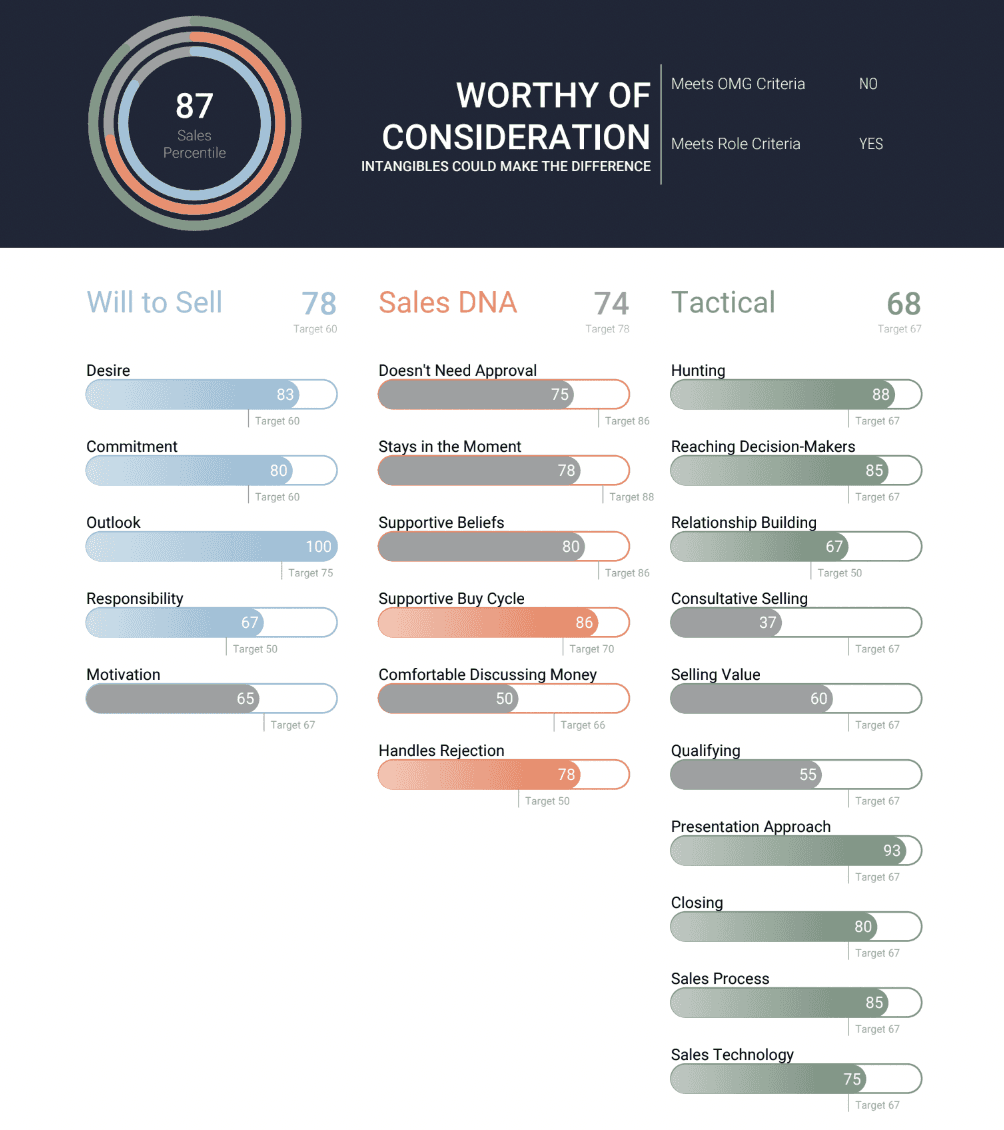
It's about ‘who can perform in the reality of this job’. So you need a process. Scorecards. Criteria. Talent analytics. Proof. Not a vibe. Not a "I know how to hire sales people / KAM / VP sales".
4) Assuming that a salesperson knows how to do their job
This is one of the big misunderstandings. You recruit someone who has already been a salesperson, so you assume they know how to sell. But ‘knowing how to sell’ is not a single skill. It's a combination of:
a set a beliefs (about value, money, what one can or can't do while talking to a prospect),
discipline (prospecting, follow-up, rigour),
methods (diagnosis, qualification, closing),
posture (tension, leadership in conversation),
and above all, adaptation to the specific motion of your company.
And selling a SaaS to inbound lead at £10k for a company still by a founder who sees his business as a lifestyle business and selling a complex solution at £150k, in a PE backed company, to multiple stakeholders are not the same thing. Neither is better. They are not just the same.
It's like saying: he knows how to write, so he can draft a legal contract.
5) Non-existent onboarding, or worse: generic HR onboarding
Let's be honest. Onboarding of a salesperson can't be done the same way as the onboarding of a developer, finance manager or ops person. Why?
Because in sales, the person has to be operational in uncertain circumstances, under pressure to deliver results, and in a changing environment. Sales onboarding must answer very specific questions:
What exactly are we selling, and to whom?
Why do customers really buy?
What are the red flags in discovery?
How do we qualify?
How do we estimate an opportunity?
What is our methodology?
What is our process, with what criteria for exiting each stage?
What constitutes a good pipeline here?
What kind of sales pitch is prohibited? What kind of sales pitch is encouraged?
How do we manage pricing, concessions, and purchases?
If onboarding boils down to:
‘Here's the deck, here's the demo, here's the price list’...
you've just turned your salesperson into a product brochure. And then you're surprised when they give demos too early, talk too much, get led on, don't make progress, have long sales cycle and ultimately ‘don't work’ ?
6) A manager who doesn't know how to manage
I know, it stings. But it's common: we promote a good performer, give them a team, and hope that magic happens. Yet managing people in a standard team is already a difficult task and not widely known. Managing salespeople is even more difficult, because you have to manage:
egos,
emotions,
motivation cycles,
limiting beliefs and headtrash,
avoidance behaviours,
and a culture of excuses that quickly takes hold if you don't maintain the framework.
And if the manager has no coaching method, no rhythm, no structure, and no healthy expectations, they are not leading a team. Sadly, it's a managerial style based on feelings.
7) Lack of clear methodology, lack of robust processes
When I started Curiosity, I assumed most companies had a sales process in place. Because that's the background I was coming from. And most organisations do believe they have one. In reality, having seen countless of sales processes, what I realise organisation have more than anything is:
a CRM with columns,
vague steps,
and salespeople moving cards on a CRM once they hear prospect telling them "this is interesting".
A methodology is a way of conducting a conversation. A process is a way of conducting an opportunity. Don't mix them. Without both, you cannot:
recruit properly (since you don't know what you're looking for),
onboard properly (since you don't know what you're teaching),
manage properly (since you don't know what you're inspecting),
coach properly (since you don't know what you're correcting).
Leading to "that sales person didn't work out"…
The false solution: recruit more
So if these gaps are not fixed, the typical fall back approach is summer up in the sentence mentioned at the start of this article: ‘I'm going to recruit three, and I hope one will work out.’ It's understandable emotionally. The organisation is hurting. Leadership want to reduce the risk. They hedge the risks.
But if the problem is systemic, recruiting more does not reduce the risk. It multiplies the cost and it will lead to burning more time:
more interviews based on gut feeling,
more prospects meetings that don't follow a prescribed approach ending up with "send me a proposal" and then the prospect ghosting,
more ‘you have to give them time’,
more churn,
more credibility damage (because the organisation sees the failures and robust hiring is rightly seen as a leadership competency),
more fatigue on the leadership side.
It's not a volume problem. Again, it's a system problem.
What to do instead: recruit a salesperson like you build a cockpit
Let me give you a simple analogy. Recruiting a salesperson is like putting a pilot in a cockpit.
If the cockpit is poorly designed, if the instruments are wrong, if the procedures are unclear, if the pilot hasn't been trained on the aircraft, and if the chief pilot doesn't know how to coach, if the pilot isn't harmed with clear checklists at take off and landing (prospecting and closing?) you can recruit the best pilot in the world...
… you still have a serious risk of crashing. So here's a healthier approach. Not ‘magical’. Just serious. And maybe a bit boring. But running a business isn't meant to be fun. It's meant to be efficient.
Step 1: clarify your sales context
Before recruiting, ask yourself some basic but rarely asked questions:
Who is our real ICP / ideal client? Not the one in the pitch deck. The real one.
How do we differentiate ourselves with them ? What type of messaging and questions ?
What pain points justify a decision now with this client ?
What is our average cycle? What are our sticking points which the sales person needs to be aware of?
What are we really selling: a product or a change?
What type of sale is it: transactional, consultative, complex?
How much money will the sales person ask for?
What level of hunting vs. nurturing?
What level of autonomy is expected?
Without this, you're recruiting a ‘salesperson’ the same way you recruit an ‘footballer.’ Ok but what? A goal keeper? A winger? A striker? A defender?
We at Curiosity have a belief when we work with sales team in transforming them: "Sell precisely". The same applies in recruitment: "Hire precisely"
Step 2: Define a scorecard, not a job description
A job description outlines tasks. A scorecard describes results and observable behaviours.
Examples of scorecard questions:
In 90 days, what needs to be true?
What does a successful week look like?
What behaviours are non-negotiable?
What technical and people skills are required?
What beliefs are necessary? (about prospecting, value, money, conflict)
What are the warning signs?
The scorecard is not an HR document, it is a leadership document that is, if necessary, evolving. Because your strategy and the markets are evolving.
Step 3: Structure the recruitment process like a sales process
A clear process is your first culture test. You don't need 12 bureaucratic steps, but you do need proof.
For example
A short, structured initial screening
A behaviour-oriented interview (not ‘tell me about your career’)
A simulation: cold call, discovery, objection pricing, etc.
Targeted references (not ‘he's nice, I have a good feeling’). Beware local employment regulations here.
And a decision based on criteria, not intuition.
Of course, feeling can be a factor as you will work with the person daily. But it cannot be the judge.
Step 4: Stop confusing ‘experience’ with ‘ability’
Someone can have 10 years of experience and zero ability useful for you. Because, for instance, they were working for the market leader, relying on a solid brand and you are a small, unknown challenger . Or have 10 years of real experience absolutely making a fortune. And therefore have earned so much cash that hunger to succeed in sales has gone... What you're looking for is:
the will to sell still strong
the ability to learn,
the ability to maintain discipline,
the ability to execute a process, yours not one he or she feels need to be followed,
the ability to handle rejection,
the ability to challenge without being aggressive.
This can be observed. This can be measured. If you test it.
Step 5: Build a sales onboarding programme worthy of the name
Sales onboarding is not a google drive with 42 powerpoint decks. It's not a bunch of meetings with colleagues. It is a programme, built and led by the sales leadership. With:
a 30-60-90 day clear path,
mastery objectives (product, market, messaging, process),
role-playing,
listening, debriefings,
and weekly checkpoints.
And above all: a clear definition of ‘what it means to sell well for us’. Because otherwise, the person will sell the way they've always sold.
Step 6: Manage and coach based on a method, not opinions
The seller must be able to answer questions from the sales manager such as:
What are you doing? - accountability -
Why are you doing it? - goal based coaching -
What are you learning? - ongoing development -
What is the next step in the process, and why? - sales skills -
Without these (and more), the manager becomes a firefighter to achieve revenue targets. With these in place, they become a coach. And a coach changes performance. 26% increase if the manager knows how to coach consultatively.
In fine: Accept a simple truth: hiring well is not enough
Even with a recruitment that brings an excellent contributor, if you don't have:
a culture that respects sales,
a clear methodology,
a robust process,
serious onboarding,
solid management,...
your salesperson will fight against the system. And if he or she sometimes win, it will to his or her intrinsic personal traits. Not in a systemic manner.
Conclusion: Build robust sales systems
If you're fed up with recruiting salespeople who ‘don't work out’ or aren't delivering as you would like them to, I understand. But the question isn't ‘where to find the right ones’.
The question is:
Does our organisation know how to make a good salesperson work?
Because yes, recruiting a good salesperson is possible. But making them successful is a matter of sales excellence (test if you have it). And that requires stopping believing in magic.
If you're ready to challenge some preconceived ideas and treat this subject as a system (culture, process, methodology, management, onboarding), let us know, we're happy to understand your vision and possible challenges to deliver it .
Subscribe to our newsletter